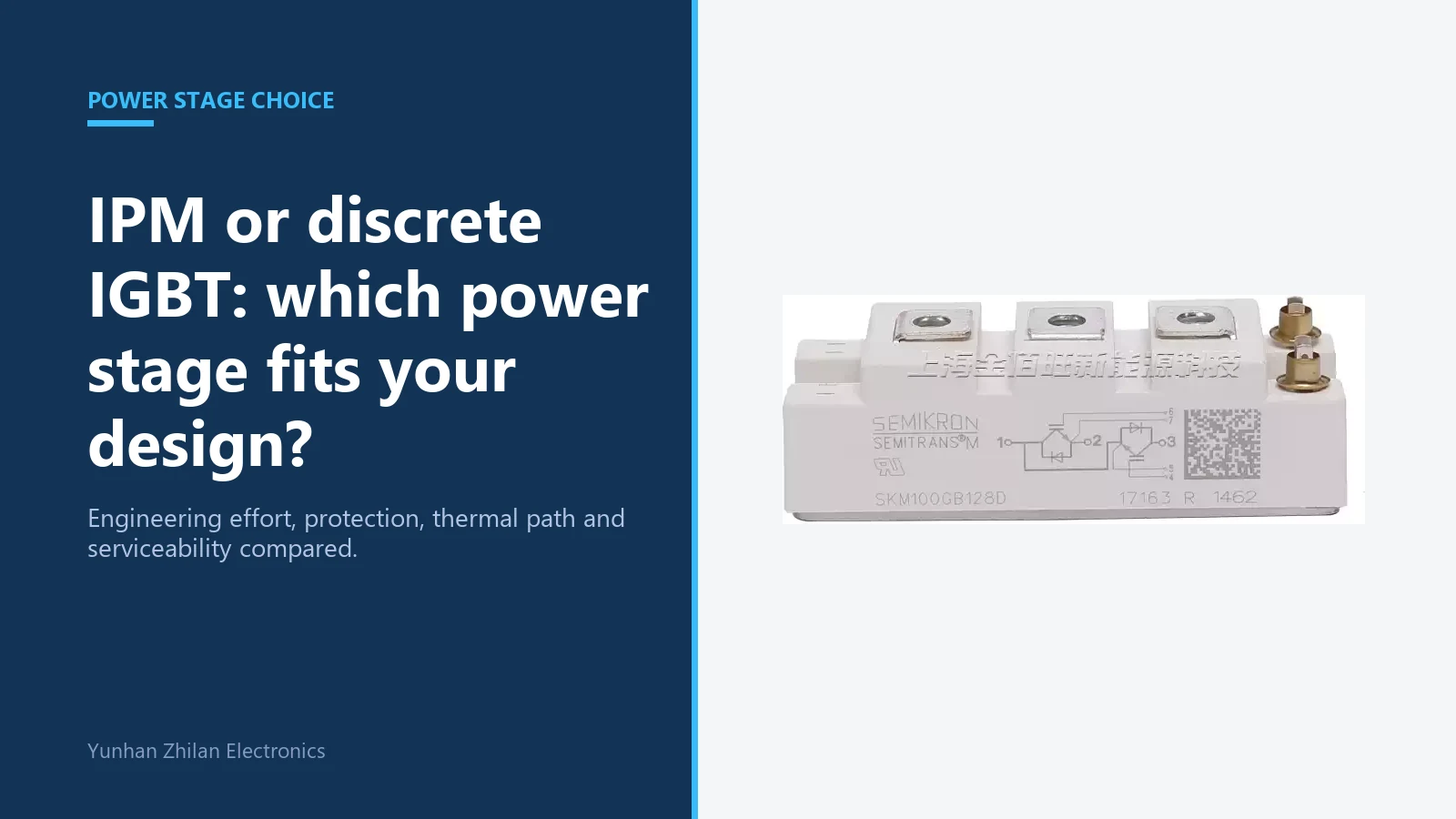
Every inverter design eventually reaches the same fork in the road. Do we build the power stage from discrete IGBTs with our own gate driver and protection, or do we buy an intelligent power module (IPM) that packages the switches, the driver and the protection into one part?
The answer is not a matter of fashion. It depends on volume, on how much power-stage engineering your team wants to own, and on how the product will be repaired in the field. This guide compares the two approaches on the points that actually decide the outcome.
What each option actually contains
A discrete IGBT stage is a set of individual devices: the IGBTs themselves, often a matching anti-parallel diode per switch, an external gate driver per switch or per half-bridge, and discrete gate resistors, desaturation detection, snubbers and current sensing around them.
An IPM integrates the IGBTs, their freewheeling diodes, the gate drive circuitry and at least a basic set of protections into a single module. Typical built-in protections include short-circuit or over-current shutdown, under-voltage lockout on the driver supply, and over-temperature detection. Some families add fault output pins so the controller can react and log the event.
Representative parts: SKiiP AC series and SKiiP NAB series modules for integrated designs, Fuji 7MBP series IPM modules, and Semikron SKM series when the power stage stays discrete.
The dividing line between a "power module" and an "intelligent power module" is the gate drive. If the module still needs your driver board, it is a power module, not an IPM.
Comparison at a glance
| Design factor | Discrete IGBT stage | Intelligent power module |
|---|---|---|
| Gate drive | You design or select it; full freedom over R(g), dead time and soft turn-off | Included and fixed by the module vendor |
| Protection | Desaturation, over-current and over-temperature built by you | Short-circuit, under-voltage lockout and over-temperature usually built in |
| Parasitic inductance | Set by your PCB layout and busbar design | Low and controlled inside the module; DC terminals are short |
| Thermal path | Your layout, your isolation, your thermal interface | Defined by the module baseplate and mounting |
| Board area | Large: driver, sensing and protection all need space | Small: the power stage becomes one component |
| Component count | High, with more solder joints and more points of failure | Low, and the internal connections are vendor-controlled |
| Engineering effort | Months of design, layout and validation | Predominantly selection and thermal design |
| Unit cost at low volume | Lower material cost, higher engineering cost | Higher material cost, much lower engineering cost |
| Unit cost at high volume | Becomes competitive once the driver is amortised | Vendor margin stays in the bill of materials |
| Field repair | Replace a single IGBT or driver component | Replace the whole module |
| Flexibility | Change R(g), dead time, protection thresholds freely | Limited to what the vendor exposes |
Where the IPM wins
1. Engineering time is the scarcest resource
A power stage built from discrete devices is a project. Gate resistor selection, dead-time tuning, desaturation blanking, snubber design, layout for low inductance and the validation campaign that follows can consume a full engineering quarter. An IPM reduces most of that to selection plus thermal design.
If the product is not a power-electronics product, paying the vendor for that engineering is usually correct. A pump controller company should not spend a year learning gate drive design.
2. Low stray inductance matters
Switching speed and loop inductance together set the voltage overshoot across the switch. An IPM with short internal DC terminals and a tightly controlled internal layout can achieve loop inductance that would take a carefully laminated busbar and a four-layer power PCB to match externally.
For fast-switching designs, or for engineers who want to keep switching losses low without an overshoot problem, that internal inductance is a real technical advantage, not just a convenience.
3. Protection you would not otherwise build
Many discrete designs ship with under-voltage lockout and a fuse, and nothing else. Short-circuit withstand and over-temperature shutdown are frequently deferred to a later revision and never implemented. An IPM closes that gap by default.
In applications where a failed power stage destroys a machine or endangers an operator, built-in short-circuit protection is worth more than the bill-of-material difference.
4. Compact, sealed and high-volume products
Where the electronics must fit into a small enclosure, an IPM compresses the power stage dramatically. The same applies where the assembly must be potted, sealed or produced on an automated line with the fewest possible process steps.
Where the discrete IGBT wins
1. You need control the IPM will not give you
Different gate resistance for turn-on and turn-off, active clamping, staged soft turn-off during a fault, or a protection threshold set to your machine rather than the vendor's default. These are normal requirements in traction, high-power drives and welding equipment, and they are exactly the things an integrated driver takes away from you.
2. High volume with a stable design
Once the driver design is amortised and the layout is proven, running the same stage across a product family is very cost-efficient. The marginal cost of an extra switch position is a device and a few passive parts, not another module.
3. Serviceability and spares
This is the argument that decides many industrial decisions. A discrete stage can sometimes be repaired by replacing one IGBT or one driver IC from stock. A failed IPM is a whole-module replacement, and for an older IPM the module may be discontinued long before the machine is.
If the equipment has a fifteen-year service life and the power stage is the wear item, plan the spare-parts strategy before choosing the architecture. A module with a long production history and multiple suppliers is safer than a highly integrated part with one source.
4. Extreme power or unusual topologies
Above a certain power level, or for topologies the module vendors do not build into IPMs, discrete devices are the only option. The same applies where the mechanical envelope does not accept any available module footprint.
Thermal design differs more than people expect
In a discrete design, heat is spread across multiple packages, and each package has its own junction-to-case and case-to-heatsink path. In an IPM, all the dies sit on one baseplate, usually with one dominant thermal path through a single insulating layer to a single heatsink surface.
Consequences worth planning for:
- The IPM concentrates the loss in one place, so the heatsink must handle a single high-density source rather than several spread sources.
- Baseplate flatness and thermal interface quality matter more, because there is no averaging between packages.
- In a discrete design you can sometimes derate only the hottest switch; in an IPM the whole module shares the temperature.
Selection checklist
Work through these questions before committing either way.
- Volume. Under roughly 5,000 units a year, engineering time usually dominates the total cost.
- Team capability. Do you have power-electronics engineers who can own gate drive and protection, and validate them?
- Switching frequency and speed. Higher speed and lower loss requirements favour the integrated packaging.
- Protection requirements. What must happen on a short circuit, and is that behaviour specified by a standard or a customer?
- Service model. Will the product be repaired at board level, or is the power stage a field-replaceable unit?
- Supply strategy. How many sources exist for the chosen part, and how long will it be produced?
- Mechanical envelope. Does an available module footprint fit, or does the design have to be discrete?
- Lifecycle. What is the service life of the machine, and who will supply the replacement module in year ten?
A practical middle path
The choice is not binary across a product family. A common industrial pattern is to use an IPM for the compact, high-volume models where cabinet space and assembly time dominate, and a discrete IGBT stage for the high-power models where switching behaviour must be tuned to the load.
Another pattern is to start with an IPM to get the product to market, then migrate the highest-volume variant to a discrete stage once the requirements are stable and the volumes justify the engineering investment. Reversing that order is much harder.
How we can help
Tell us the bus voltage, the continuous and peak current, the switching frequency, the cooling method and the annual volume. We will tell you which of the two architectures fits, and which modules we can supply and keep supplying.
If you are replacing a discontinued IPM, send the original part number and a photo of the module and its terminals. Matching the footprint and the internal protection behaviour is usually the hard part, not the ratings.


